
Slots
Slot Volatility Explained
Volatility (also called variance) describes how a slot's returns are distributed. Low-volatility slots tend to pay smaller wins more often; high-volatility slots pay less often but can produce larger wins. Volatility does not change a game's RTP and never guarantees a win.
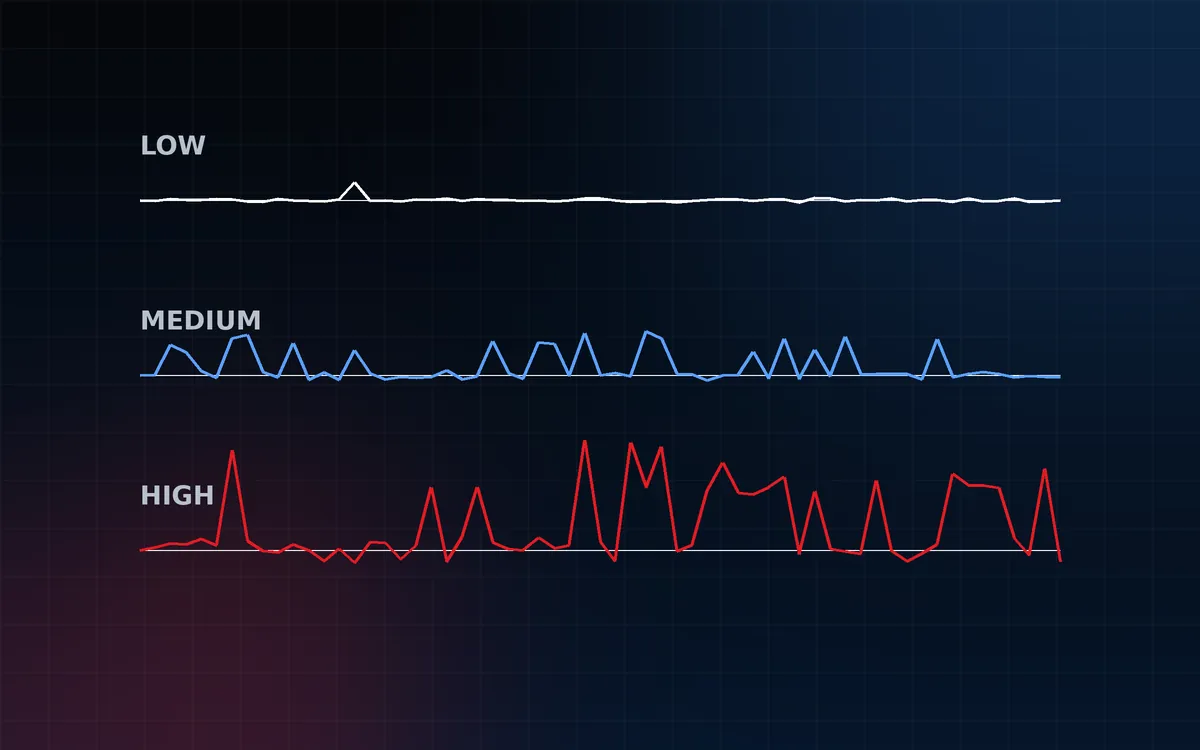
Low, medium and high volatility
| Aspect | Low volatility | Medium volatility | High volatility |
|---|---|---|---|
| How often wins land | More often | Moderately | Less often |
| Typical win size | Smaller | Mixed | Larger, but rarer |
| Swings in balance | Gentler | Moderate | Large, with long losing stretches possible |
| What it can feel like | Steady, slower-moving sessions | A balance of both | Long quiet spells, occasional big features |
Hit frequency
Hit frequency is the share of spins that produce any win. A game with a 25% hit frequency pays something on about one spin in four over the long run, but many of those wins can be smaller than the stake. Hit frequency and volatility are related, but a game can pay often and still be volatile if most of its value sits in rare features.
Same RTP, different experience
Two slots can both have a 96% RTP and feel completely different. In the low-volatility game, that 96% is spread across many small wins. In the high-volatility game, a large part of it comes from features that most sessions never trigger. Over a short session, the high-volatility game is more likely to finish well below its RTP, and occasionally well above.
How to tell a game's volatility
- Many game studios state volatility in the information screen, often as a scale or a rating.
- There is no universal standard, so one studio's "high" may not match another's.
- Clues in the paytable: very large top prizes and big feature multipliers usually point to higher volatility.
Volatility and your budget
High-volatility games can use up a fixed budget quickly during losing stretches. That is part of how they are designed, not a sign that a big win is coming. If you choose one, reduce your stake so your budget lasts the time you planned, and stop when the limit is reached.
Volatility describes risk; it is not a strategy. No choice of volatility changes the house edge or makes a profit likely.