
Table Games
How to Play Roulette
In roulette you bet on where a ball will land on a spinning wheel of numbered pockets. You can bet on single numbers, groups of numbers or colours; the fewer numbers a bet covers, the higher it pays and the less likely it is to win.
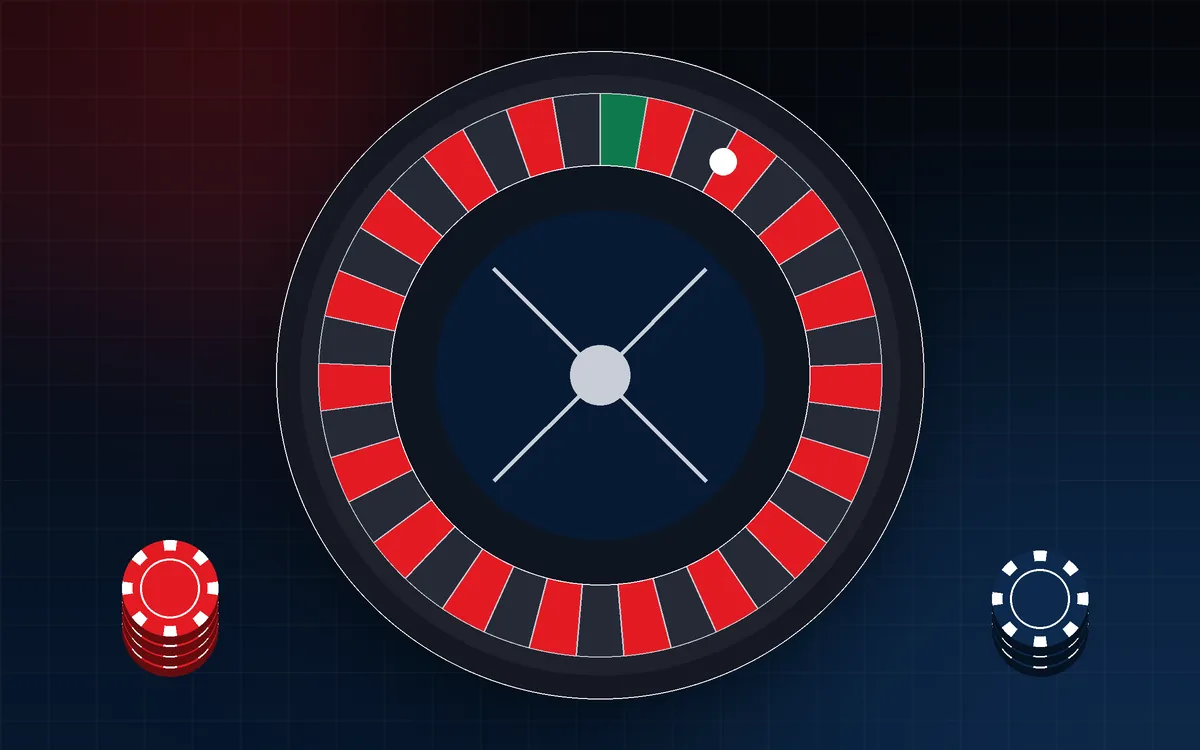
European and American wheels
| Wheel | Pockets | House edge |
|---|---|---|
| European | 37 (1–36 plus 0) | 2.70% |
| American | 38 (1–36 plus 0 and 00) | 5.26% (7.89% on the five-number bet) |
The extra double-zero pocket nearly doubles the house edge, so the single-zero wheel is the better value of the two.
Bets, payouts and probability
| Bet | Numbers covered | Payout | Chance of winning (European wheel) |
|---|---|---|---|
| Straight up | 1 | 35:1 | 2.70% |
| Split | 2 | 17:1 | 5.41% |
| Street | 3 | 11:1 | 8.11% |
| Corner | 4 | 8:1 | 10.81% |
| Six line | 6 | 5:1 | 16.22% |
| Dozen or column | 12 | 2:1 | 32.43% |
| Red/black, odd/even, 1–18/19–36 | 18 | 1:1 | 48.65% |
Bets on numbers placed inside the grid are called inside bets. Bets on the areas around the grid (colours, dozens, columns) are outside bets. The zero is not red or black, odd or even, which is where the house edge comes from.
La partage and en prison
Some single-zero tables apply la partage: if zero comes up, half of each even-money bet is returned. Under en prison, even-money bets stay on the table for the next spin instead. Both lower the house edge on even-money bets to about 1.35%. The table rules state whether either applies.
Betting systems
Progressions such as doubling after every loss (the Martingale) change how your stakes rise and fall, not the odds of any spin. Long losing runs happen, stakes grow fast and table limits cap how far a progression can go. No system overcomes the house edge.
Key points
- Every spin is independent. Previous numbers do not affect the next.
- Choose a single-zero wheel where possible.
- Higher payouts come with lower chances of winning.